
WeChat Official Account
Tel: 86 023-72183502

News
In advanced packaging, a Solder Ball only tens to hundreds of microns in Diameter not only provides electrical interconnect and mechanical support, but may also introduce an invisible reliability risk - alpha particles.
These alpha particles mainly come from trace radionuclides in Tin-Based materials. When they enter sensitive chip regions and deposit enough charge, they may flip a stored "0" or "1". The device usually is not damaged immediately, but data may already be wrong.
As feature sizes shrink, operating voltages drop, and flip-chip, wafer-level and 2.5D/3D packaging advance, the distance between Solder Ball, micro-bumps and chip active regions keeps decreasing. Low-alpha tin has therefore become an important requirement for high-Density packaging materials.
After an alpha particle enters a semiconductor, it deposits energy along its track and generates large numbers of electron-hole pairs. Under internal electric fields and carrier diffusion, some of that charge may be collected by storage nodes, transistor drain regions and other sensitive areas.
Every storage node has an upper limit of disturbance it can tolerate, called the "critical charge." When collected charge exceeds this limit, the node's original state may change.
Two effects are most closely related to low-alpha packaging materials.
The first is single-event upset, or SEU. It can flip data in a memory cell, register or latch from "0" to "1" or from "1" to "0". Such errors usually do not permanently damage the device and can be recovered by rewrite, reset or error-correction mechanisms.
The second is single-event transient, or SET. An alpha particle may generate a brief anomalous pulse in combinational logic or analog circuits. If the pulse is not attenuated during propagation and is latched by downstream circuitry, it may produce an erroneous output.
It should be noted that an alpha particle entering the package structure does not mean the chip will necessarily err. Actual risk also depends on device structure, sensitive-node location, operating voltage, critical charge, particle energy, distance between interconnect materials and the active region, and whether the System has error-correction capability.
The role of low-alpha tin is to reduce soft-error risk caused by packaging materials - not to eliminate all soft errors.
Tin itself is not the main issue; what truly matters are the extremely low levels of radioactive impurities it may contain.
Low-alpha tin primarily controls lead-210, polonium-210, uranium, thorium and their decay products. One decay path of particular concern is:
Lead-210 → Bismuth-210 → Polonium-210 → Lead-206 + alpha particle
Lead-210 and bismuth-210 mainly undergo beta decay; the resulting polonium-210 releases alpha particles.
One easily overlooked point: low total lead content does not necessarily mean radioactive lead-210 is low.
Total Pb data only indicates "how much lead" is in the material, not "how much radioactive lead." Lowering total lead usually helps reduce potential risk, but total Pb alone cannot determine whether a material meets a low-alpha grade.
Another issue is radionuclide "regeneration." Purification may temporarily lower polonium-210, but if lead-210 is not adequately removed, new polonium-210 can form during storage and raise the alpha emission rate again.
Therefore, ultra-low-alpha or extremely-low-alpha products require not only outgoing inspection but also storage retests to observe long-term Stability.
Radioactive impurities do not come from raw materials alone. Tin ore, crude tin, recycled feedstock and Alloy elements may introduce contamination; crucibles, molds, furnaces, production dust, Additives and packaging materials may also cause secondary contamination during processing.
The purer the material, the less negligible even trace contamination from equipment and the environment becomes.
"High purity" and "low alpha" are related but different concepts.
High-purity tin mainly concerns bulk tin purity and conventional chemical impurities such as Pb, Bi, Sb, Cu and Fe.
Low-alpha tin must also tightly control radionuclides such as lead-210, polonium-210, uranium and thorium, and confirm alpha emission rate through actual testing.
In other words:
High-purity tin answers "how many chemical impurities"; low-alpha tin answers "how many alpha particles the material actually emits."
Even two lots of tin with similar chemical purity may differ markedly in radionuclide composition and alpha emission rate. Therefore, 5N, 6N and similar purity grades cannot replace low-alpha testing.
High purification is an important Basis for low-alpha performance, but high-purity tin cannot be equated directly with low-alpha tin.
Low-alpha materials are typically evaluated by the number of alpha particles detected per unit area per unit time. A common unit is:
cph-cm⁻²
Simply put: the number of alpha particles detected per hour per square centimeter of sample surface.
Common nominal grades include:
Material Grade | Alpha Emission Rate |
Low-alpha grade | <0.01 cph-cm⁻² |
Ultra-low-alpha grade | <0.002 cph-cm⁻² |
Extremely-low-alpha grade | <0.001 cph-cm⁻² |
However, different institutes and companies do not fully agree on the boundaries of names such as Low Alpha and Ultra-Low Alpha. When judging product performance, prioritize the measured emission rate rather than the grade Name alone.
At ultra-low and extremely-low alpha levels, results are easily affected by sample area, test time, detection efficiency, instrument background, cosmic rays, radon contamination and sample-surface electrostatics.
A complete test report should state not only the emission-rate value but also the instrument, effective test area, test duration and related details.
First line of defense: source material control
Material control includes screening low-radioactivity feedstock, purifying bulk tin and Alloy elements, clean melting and Alloying, fine forming, finished-goods testing and clean packaging.
Ordinary tin, recycled tin and low-alpha materials should also avoid cross-contamination. Ultra-low and extremely-low alpha products should use dedicated equipment, independent material flow, or validated line-clearance procedures.
Second line of defense: package-structure shielding
Polymer or dielectric barrier layers can be placed on the chip surface or above sensitive regions so alpha particles lose some energy before reaching the active area.
However, thicker barriers are not always better. Excess thickness may increase thermal resistance, interfacial stress and package size, so barriers are usually only an auxiliary measure.
Third line of defense: circuit and System fault tolerance
Hardened latches, redundancy, error detection and correction codes, and data backup/recovery can reduce soft-error consequences, but may also increase chip area, power and design complexity.
These three measures act on the radiation source, particle propagation path and device response respectively - they are complementary, not substitutes, and should be combined according to product reliability requirements.
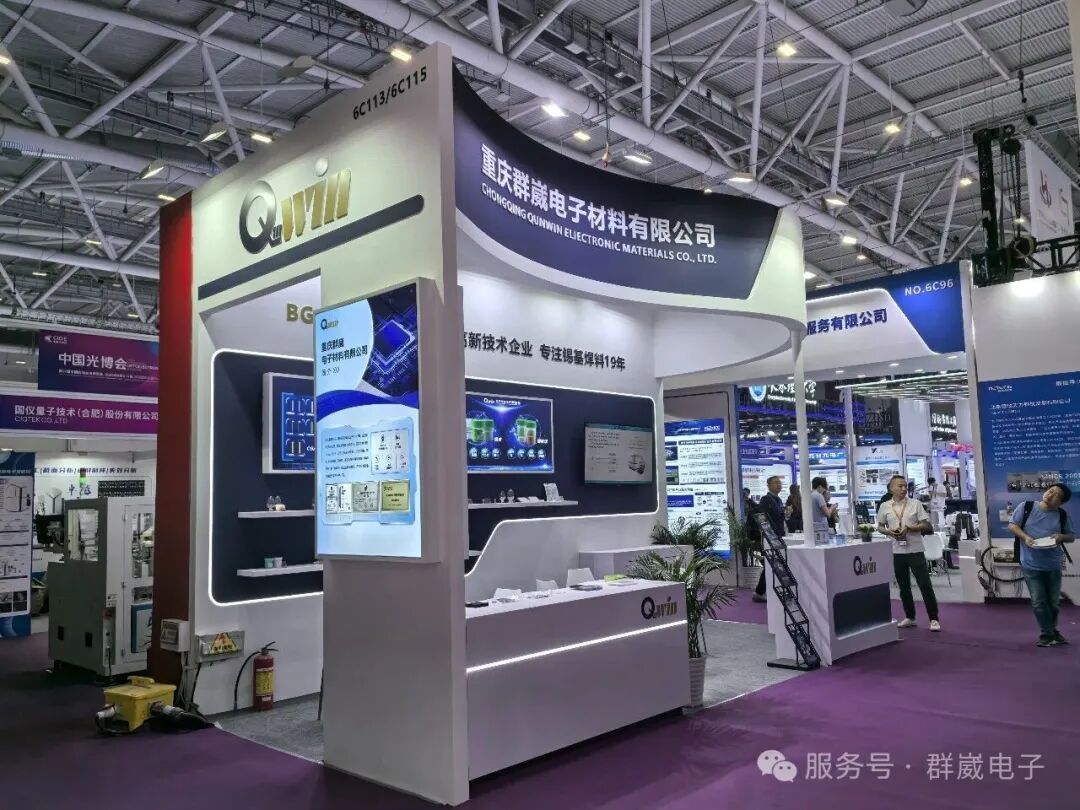
Chongqing Qunwin Electronic Materials Co. Ltd. was founded in 2007. It is a National High-tech Enterprise and a national-level SRCI "Little Giant" Enterprise, long focused on R&D, production and sales of advanced packaging materials such as BGA Solder Ball, fine-pitch Solder Ball, CCGA Solder Column and Solder Paste.
The company has built technical capability around fine forming, precision screening, Alloy control and product testing. It can manufacture high-precision fine Solder Ball from 30-100 μm and Develop Low Alpha Solder Ball products for sizes within 100 μm.
For low-alpha testing and control, the company is equipped with an XIA UltraLo-1800 ultra-low-background alpha particle counting System, linking low-alpha feedstock, precision forming and finished-goods testing into a quality chain from raw-material control to product verification - supplying low-radioactivity Tin-Based interconnect materials for high-Density, high-reliability advanced packaging.
In the advanced packaging era, a Solder Ball is no longer merely a simple soldering and interconnect component.
As interconnect dimensions shrink and materials move closer to chip active regions, even trace radionuclides in materials become variables that reliability design must consider.
The core of low-alpha tin is not merely making tin "purer," but applying end-to-end control over feedstock, purification, Alloying, fine forming, testing and packaging.
For high-end memory, flip-chip and 2.5D/3D packaging, evaluating Tin-Based interconnect materials in the future must ask not only:
How pure is it?
but also:
How many alpha particles does it actually emit?